Social Market Intelligence

Five Reasons Social Media ROI Will Never Die

I'm a big fan of Marshall Kirkpatrick (@marshallk). He's one of the best voices behind ReadWriteWeb, and one of the few people that delivers consistently good reporting and analysis on social media technology. But Marshall's recent piece on the supposed death of Social Media ROI really deserves a crushing response. Not only is social media ROI decidedly undead, its death shouldn't be longed for by marketers in the first place. The fact that ROI is such an albatross around marketing's neck is no one's fault but marketers, and the way to put it in its proper place is to tackle it head on—something marketers have failed to do for more than a decade. It is precisely the treatment of ROI as Marshall frames it that ensures its persistence as a bludgeon against lightweight marketing.

I've written about the challenges of ROI for marketers for more than 10 years. In fact, it's somewhat depressing to point out that an article I wrote for MarketingProfs in 2003 would still suffice as a counterpoint to Marshall's depiction of ROI today. ROI is an important tool of limited value, but it's importance is magnified ten-fold because marketers steadfastly refuse to understand it, much less understand why it is so frequently used by CFOs and CEOs to stop marketers dead in their tracks.

So here are five reasons Social Media ROI will not die:

1) ROI is a fundamental financial equation. Saying ROI is dead is like saying Balance Sheets are dead. We've got liabilities and assets—we just don't need to calculate them anymore. Right. ROI is not, as marketers relentlessly frame it, a generic synonym for "results" or "value". Using the term in that way makes marketers sound clueless to anyone serious about business and finance—ie: the CEO and CFO. It confirms in their minds that marketers are business lightweights who must be kept on a very short budgetary leash. The ~only!~ answer to the question "What is the ROI of x?" is a number. Period. If you can't determine what that number is, don't substitute another answer and call it ROI. No one is fooled by that but other marketers.

2) ROI is a metric tailor-made for a business environment fixated on short-term results. For better or worse (well, it's definitely for worse) we have created a business world in which short-term results are king. Quarterly results drive everything from sales bonuses to stock value. ROI as a financial metric requires that the return is realized in the same reporting period as the investment, which feeds perfectly into the short-term focus. There are plenty of reasons to argue for longer-term metrics of value creation in marketing, but until marketers can demonstrate mastery of short-term financial results, no one is going to listen to them.

3) ROI drives critical data and discipline. It's like the speedometer in your car—it tells you how efficiently you're converting resources into forward momentum. That's important because you have limited resources to get where you're going, and if you run out of fuel on the way, you're out of the game. Trouble is, it doesn't tell you ~where~ you're going, and you might be very efficiently moving in entirely the wrong direction, which is why it's so important for marketers to master it and move on. But if you can't demonstrate you know how to create momentum, no one cares what a genius you are about strategy.

4) ROI is really about trust. CEOs understand that marketing is critical. They just don't trust marketers with a budget, precisely because marketers can't seem to grasp the most basic test of accountability: If I give you a dollar to invest, how much are you going to give back? You know, in ~dollars~. The trust issue is really what articles like Marshall's are trying to get at, and why marketers wish ROI would go away. They want marketing's value to be so self-evident that no one will question its activities any more. All I can say, as a CEO, is if your best argument for a program is that IBM is doing it, you haven't earned an iota of trust in your abilities.

5) ROI isn't really a hurdle at all. Look. It's hard to measure the value of complex activities and intangible outcomes. Good CEOs and CFOs get that. Particularly when it comes to new technologies and programs. But you will always find a reflexive ROI roadblock if you can't demonstrate due diligence in mapping the relationship between social media metrics of activity (follows, likes, etc.) and worthwhile financial outcomes. If you don't have a strong ROI case, you should be able to win the day by starting with a measurable business objective—to increase sales, to reduce costs, to improve customer retention—constructing a credible hypothesis for how social media can achieve those objectives, and designing limited and agile deployments of social media activities to test your hypothesis and measure results. If that doesn't fly, your problem may be more political than financial. Read the post I wrote on The Four Percent Solution for some ideas on how to navigate roadblocks.

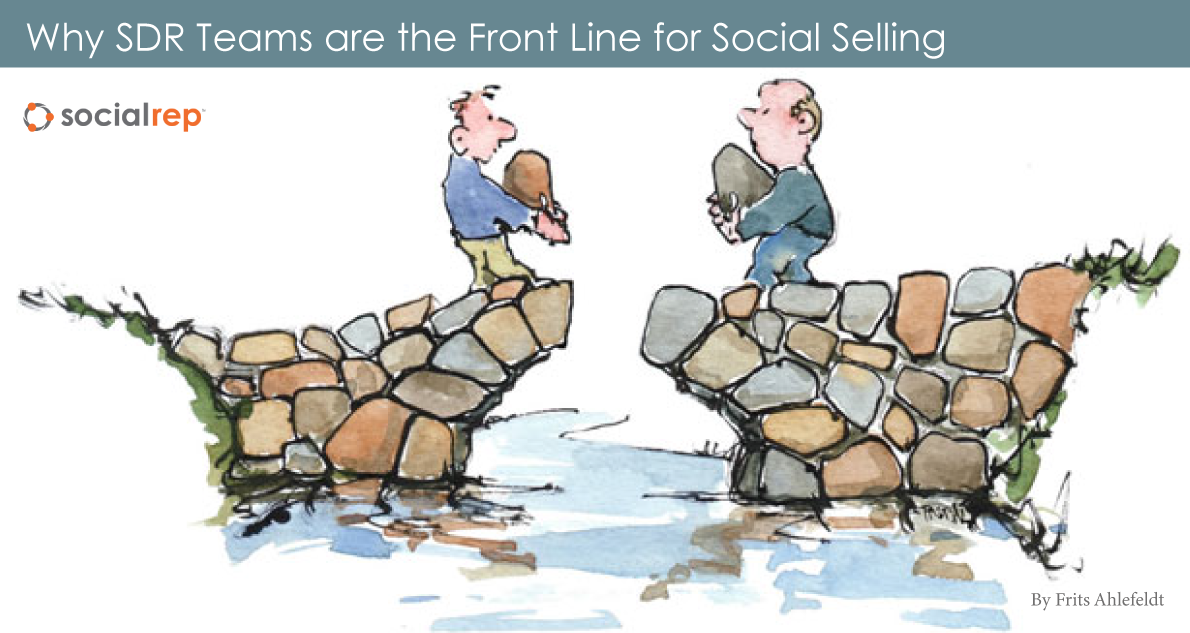
ROI is only kryptonite to marketers because they don't give it the respect it deserves. Instead of wishing it away, marketers should embrace it as an important financial metric that can help them apply the scientific method to their social media program. Doing so will not only offer new insights into what really matters in marketing engagement, it will help bridge the gap between marketing and finance teams, and do a world of good in building credibility for marketing programs.

If you want to really learn about Marketing Finance, I would recommend reading everything you can find from Jonathan Knowles. He's taught me most of what I know about marketing finance that has any value. Disclosure: After many years of collaboration, Jonathan is an advisor and investor in SocialRep. But his content speaks for itself.

In Social Media, Value Matters More than Volume

As social media goes mainstream for corporate marketing, far too many marketers are getting caught up in activity metrics rather than value. Klout. Likes. Follows. Retweets. Everything is about volume of engagement, with little if any focus on the value of engagement. Recently I heard a senior executive at a major national brand brainstorming a campaign to improve his company's Facebook "Likes". It was parody. He was fixated on a single metric, and kept asking for help estimating a conversion of Facebook "Likes" to television advertising equivalents. When it was pointed out that likes don't actually mean someone likes you (Bank of America's customers "Liked" their Facebook page so much, the torrent of hate mail forced BofA to abandon the page) it had no impact. He was insistent: How fast could a campaign drive up "likes", and how could that number be converted into advertising equivalents?

I don't doubt there was a compelling motive behind the executive's request, probably driven by budget politics. But it wasn't an isolated case. At SocialRep, the more service requests we see coming through social media, the more we see a market fixated on flavor-of-the-moment activity metrics. It's a mindset much closer to affiliate marketing than market strategy, fueled by pundits pushing trends and tactics with little depth of analysis.

Take two of the latest big news items in retail marketing. Best Buy and Kodak were celebrated social media case studies over the past 24 months, and both are now being pilloried by the market for poor customer and business fundamentals. This isn't the fault of social media, but where are the gurus and analysts that cheered them for their cutting edge use of Social Media and SocialCRM? Why aren't they deconstructing the delta between the engagement they lauded and the customer value created? The data is available, and in fact I analyzed some of Kodak's social media tactics and missteps 2 years ago. But today, everyone's moved on to the next big thing for 2012, or whatever 12 steps you should be following to be socially successful this year.

There are important things to learn through activity and engagement, but there are equally valuable lessons to learn from patient listening and analysis. What distinguishes our most successful customers is the discipline to build engagement on a foundation of strategic insights about their market and position, instead of rushing to engage just to compete on activity metrics. One of our clients, a multi-national business in a highly visible space, is surrounded by competitors throwing money at every social channel available. YouTube. Twitter. Facebook. LinkedIn. Everything highly polished and skin deep. By contrast, we spent a year with our client building a highly focused index of market intelligence spanning several products and competitive sets. Only now are we developing a global strategy that matches selected social channels with the right focus and message for engaging the right prospects. But based on a foundation of market intelligence, tactics now have direction and metrics have focus.

I'm a fan of good trend watching and 12-step guides to leveraging the latest technology for social media success. But don't get lost in the trenches chasing activity metrics for their own sake. One of the greatest values of social media is the ability to hear your market more effectively to guide strategy. There aren't easy short-term metrics for strategy, but strategy makes your metrics a lot more meaningful.

Mapping the Frontier of Marketing Finance

Like so many aspects of our economic system, marketing as a corporate function is facing significant disruption. Competition is growing globally, conversion rates are dropping, technology is increasingly complex, customers are more informed and demanding—and behind it all, the CFO is demanding a lot more accountability for how marketers generate shareholder value. No wonder the average shelf-life of a CMO is only 18 months.

The simple and unfortunate reality is that the marketing profession is not sufficiently prepared to reliably generate the markets businesses need to drive sustainable profits into the future. When corporate strategists were convincing boards that marketing was just a line function to be efficiently managed, marketers were blowing budgets on overinflated brands. When the dotcom bubble burst and marketers were pushed up against the wall and pressed to explain their math for creating value, they simply parroted the simplistic frame of ROI instead of buckling down and learning the fundamentals of corporate finance. Ten years down the road, so-called marketing gurus are still stuck at ROI, or worse, manufacturing pseudo financial concepts prettied up for the social media age, like "Return on Community".

Among the very small universe of truly finance-savvy marketing visionaries, SocialRep is incredibly fortunate to count Jonathan Knowles as a long-term partner, collaborator, customer, and most important of all, a true angel. Jonathan has the rare ability to synthesize financial and marketing outlooks, bringing a sensibility to marketing that unlocks its strategic potential for the boardroom—a sensibility that also cuts through the hype of social media marketing.

In this video, Jonathan discusses several of the core concepts of marketing finance, including the pitfall of blind reliance on Marketing ROI to carry the day with the CFO.

Syndicate content